An Oxford University study showed, in June 2020, that despite the Spanish Flu pandemic of 1918-1919 and two subsequent flu pandemics in the USA in the 1960s and 1970s had proven to be multiple times more lethal than COVID-19, that they had very limited impacts on the stock market at the time.
In comparison, the Oxford University article reports that:
The evidence we amass suggests that government restrictions on commercial activity and voluntary social distancing, operating with powerful effects in a service-oriented economy, are the main reasons the U.S. stock market reacted so much more forcefully to COVID-19 than to previous pandemics in 1918–1919, 1957–1958, and 1968
Scott R Baker, Nicholas Bloom, Steven J Davis, Kyle Kost, Marco Sammon, Tasaneeya Viratyosin, The Unprecedented Stock Market Reaction to COVID-19, The Review of Asset Pricing Studies, Volume 10, Issue 4, December 2020, Pages 742–758, https://doi.org/10.1093/rapstu/raaa008
This suggests that government action, which seems to have put political decisions before health-based ones, has caused the instability in the stock market.
Another area, which has seen this type of growth is in airport security. Straits research show the size of market and projected growth:
The global airport security market size was valued at USD 11.5 billion in 2021 and is expected to expand at a compound annual growth rate (CAGR) of 7.8 % from 2022 to 2030 and reach around USD 22.7 billion.
Research, Straits. Airport Security Market Growth, Share, Forecast to 2030. https://straitsresearch.com/report/airport-security-market. Accessed 31 Mar. 2023.
Airport security, in a similar way to COVID-19, has been very much driven by government. Does this illustrate any objective or agenda hidden behind policy-making and decisions made by governments in relation to COVID-19 non-pharmaceutical interventions (NPI), therapeutics, vaccines, public health information and political communications?
The Oxford University Press (OUP) article compares COVID-19 with Spanish Flu and two further flu epidemics, which took place in the late 1950s and 1960s in terms of excess deaths to date of publication, other circumstances such as war and measures to control the spread of the virus in terms of stock market volatility.
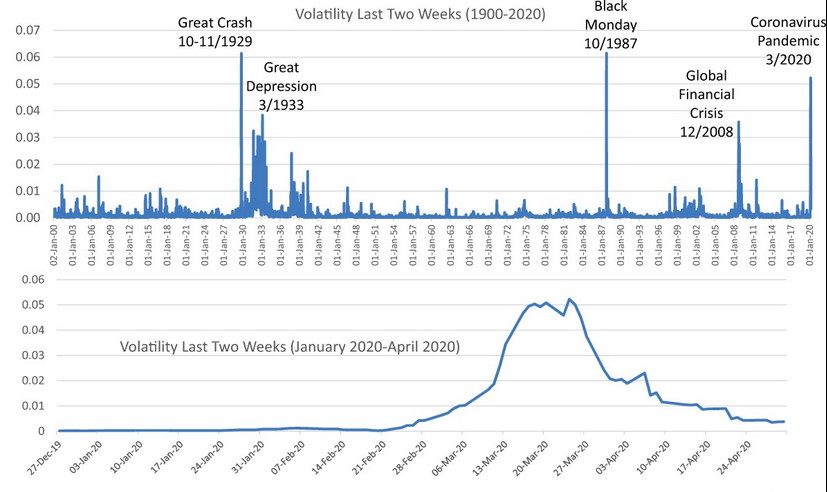
Realized U.S. stock market volatility, January 1900 to April 2020
The graph above showed that something major happened from February 2020. In response to this activity, I would like to look at a timeline of other events, which took place between February 2020 and May 2020 to see if they coincide with stock market activity.
Something caused the stock market to stabilize during March 2020, which is when countries were going into unprecendented lockdowns. It is worth mentioning at this point that all three national lockdowns in the UK were started after the peak of COVID-19 cases, as if to give the lockdown credit for reducing the spread of infections. The timeline of events could also be viewed in terms of how many official cases and deaths from COVID-19 were being reported. This might show whether the focus on vaccines had more to do with health or something else, such as stabilizing the stock market.
Would COVID-19 vaccinations have been pursued in the way they were if the objective was just to save lives and end the pandemic? What kind of roll-out strategy would have been involved. The OUP mentions the swift creation of a flu vaccine in 1958 to compare with:
Governmental authorities in the United States refrained from NPIs in response to the 1957–1958 influenza pandemic (Henderson et al. 2009; Ferguson 2020). As Henderson et al. (2009, p. 270) put it, “measures were generally not taken to close schools, restrict travel, close borders, or recommend wearing masks. Quarantine was not considered to be an effective mitigation strategy.” The focus was instead on surveillance, rapid vaccine development, and, once developed, the priority deployment of the vaccine to healthcare workers, persons providing basic community services, and persons at high health risk from the virus. Those who contracted the virus were encouraged to rely on home health care except in cases involving complications or aggravating conditions.
Scott R Baker, Nicholas Bloom, Steven J Davis, Kyle Kost, Marco Sammon, Tasaneeya Viratyosin, The Unprecedented Stock Market Reaction to COVID-19, The Review of Asset Pricing Studies, Volume 10, Issue 4, December 2020, Pages 742–758, https://doi.org/10.1093/rapstu/raaa0
Therefore, there was little impact on the stock market caused by the 1957-1958 influenza pandemic, with the swift development of a vaccine to protect those most in need: healthcare workers, those most exposed from working in the community and people with high health risks from the virus. NPI such as closures or mask use were not used because they were not considered an effective strategy, even though flu is much more severe in young people than COVID-19 was in early 2020.
The above suggests to me that the objectives in 1957-1958 prioritised people’s health, the community and bringing life back to normal over other interests. From February 2020 there were “There were more than 1,100 daily stock market moves (up or down) greater than 2.5% from 1900 to 2019”. I will try to see what may have caused these.
Referring now to Wikipedia’s timeline of events from the beginning of the COVID-19 pandemic, a day after the first recorded death from COVID-19 on 5th March 2020, “6 March – The Prime Minister announces £46 million in funding for research into a COVID-19 vaccine and rapid diagnostic tests. During a visit to a laboratory in Bedfordshire, he says: “It looks like there will be a substantial period of disruption where we have to deal with this outbreak.” (WIKIPEDIA).
On 16th March 2020, Neil Ferguson publishes a paper on NPIs in which he suggests the strategy to “flatten the curve” to delay the peak of the disease so that health systems and emergency units are not overwhelmed. Ferguson’s prediction of deaths was set to 250,000. The number of UK deaths from COVID-19 on 23rd March 2023, in the fourth year of the pandemic, is 221,591.
Then, on the 21st April: “Matt Hancock says the government is “throwing everything” at developing a vaccine as he announces £42.5m for clinical trials being conducted by Imperial College London and the University of Oxford.” (WIKIPEDIA).
As we now know, from February 2020, the stock market reacted to the coronavirus outbreak, starting in February 2020, although the US and UK governments didn’t seem to take the virus threat particularly seriously. It then seems that government responses and restrictions, much wider in scope than preceeding pandemics, which were more lethal than COVID-19, caused the stock markets to fall, which were then buoyed up by the promises of vaccines and therefore market recovery.
 Dairy of A Nonny Moose