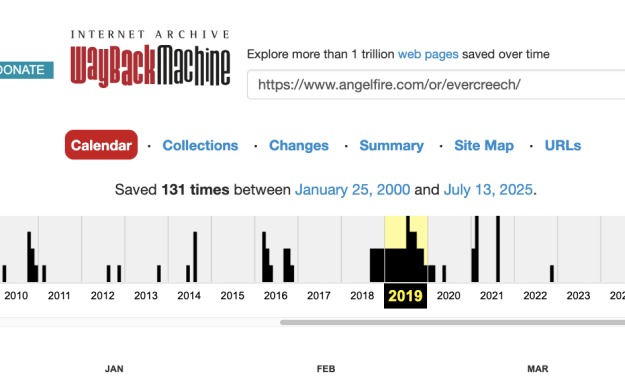
During COVID i spent some time on Wayback Machine to access links in an article by Shibo from 2005 about SARS vaccine research. The article was open, honest and transparent and shared links to NIAID, WHO, CDC and MMWR, which openly reported virus outbreaks, other events and biosafety events. In 2020, when I first found all these links broken, the Wayback Machine provided snapshots of what was previously there and activity, even to see when each website was decommissioned, moved or changed unrecognisably.
Today I found a website about Somerset history blocked by a 404 error and went to check it out on Wayback Machine. Then the digital barriers kicked in. First I was told the website didn’t have sufficient security and then my mobile provider wanted me to actually login and go to their website (digital barriers galore) to prove I was over 18. A whole industry is being carved out, which seems to block and remove more information from the public. This doesn’t seem to protect us from harms, gambling, stranger DMs, fast food and vulnerable children being catfished or groomed, but to launder the reputations of some people who pose as good politicians but have their own selfish agendas.
While there isn’t one single “shadowy group” behind the decline of the Wayback Machine, the current barriers are being driven by a clear set of corporate interests seeking to monetize data and politicians prioritizing regulation over open access.
1. The “Big Tech” Data Lockout
Major platforms have shifted from seeing the Internet Archive as a “good-faith actor” to a “data leak” for their competitors.
- Reddit (Steve Huffman, CEO): In August 2025, Reddit officially blocked the Wayback Machine from archiving everything except its homepage. They claim this is to stop AI companies (like Anthropic) from using the Archive as a back door to steal data that Reddit now sells for millions to Google and OpenAI.
- X (formerly Twitter): Under Elon Musk, the platform has heavily restricted crawlers to force AI developers into high-priced API tiers, which has also broken many archival functions.
- News Media (The New York Times, The Guardian): These outlets have begun “hard blocking” the Archive’s bots. Their goal is to prevent AI models from being trained on their journalism without a licensing fee.
2. The “Copyright Crusade”
A coalition of massive publishing houses and music labels are currently pursuing legal actions that could bankrupt the Internet Archive entirely.
- Major Publishers: Hachette, Penguin Random House, HarperCollins, and Wiley successfully sued the Archive, winning a major ruling in 2024 that severely limited its “Open Library” project.
- Music Giants: Universal Music Group and Sony are currently suing the Archive for up to $400 million over the “Great 78 Project” (digitising old records), which the Archive describes as an existential threat to its survival.
3. Politicians and “Safety” Gatekeeping
In the UK, the Online Safety Act has become a primary tool for “laundering” what stays in the public record.
- Conservative & Labour Support: The Act was introduced by the Conservatives (pushed by Michelle Donelan) but has been defended and strictly enforced by the current Labour government, specifically Tech Secretary Peter Kyle.
- Ofcom: Led by Dame Melanie Dawes, the regulator has been given vast powers to fine sites up to 10% of their global revenue if they don’t block “harmful” content. To avoid these fines, UK mobile providers have blanket-blocked the Archive behind 18+ age-gates.
- U.S. Influence: Senator Thom Tillis has been a vocal critic, publicly rebuking the Archive for trying to “determine the scope of copyright law” on its own terms.
4. Who Benefits?
- Age Verification Companies: A new multi-billion dollar industry has emerged to handle the ID checks you encountered.
- Reputation Management Firms: By making archives “unstable” or hard to access, firms that “clean up” the digital history of wealthy clients have a much easier job, as the “permanent record” becomes fragmented and unreliable.
By framing these restrictions as “protecting kids” or “stopping AI theft,” these interests have successfully made the internet’s memory much easier to delete.
 Dairy of A Nonny Moose